

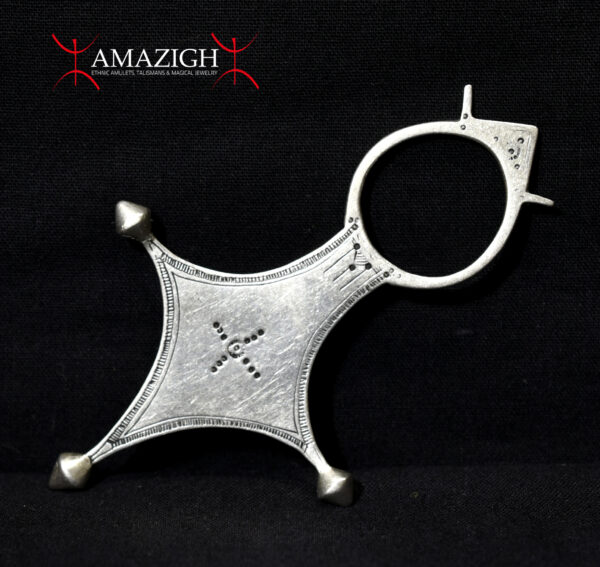
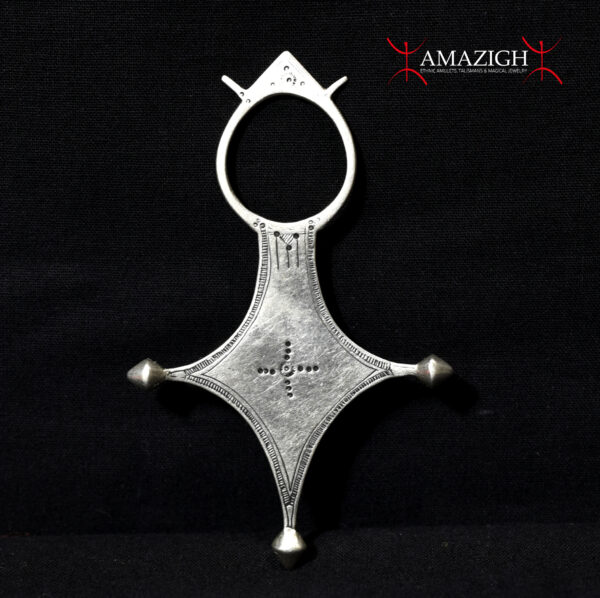
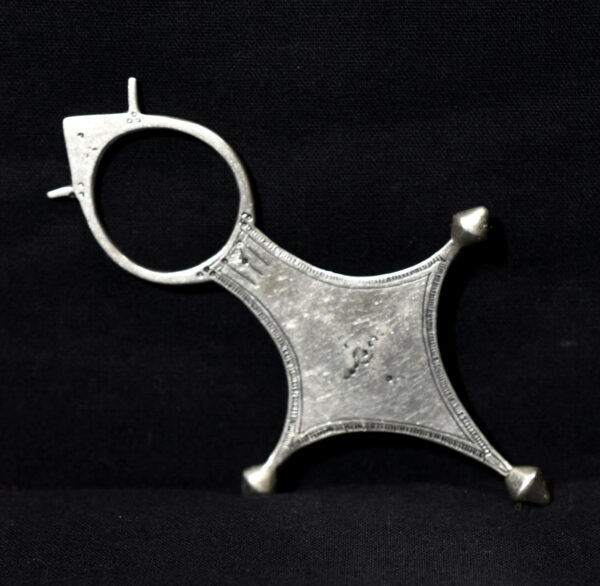
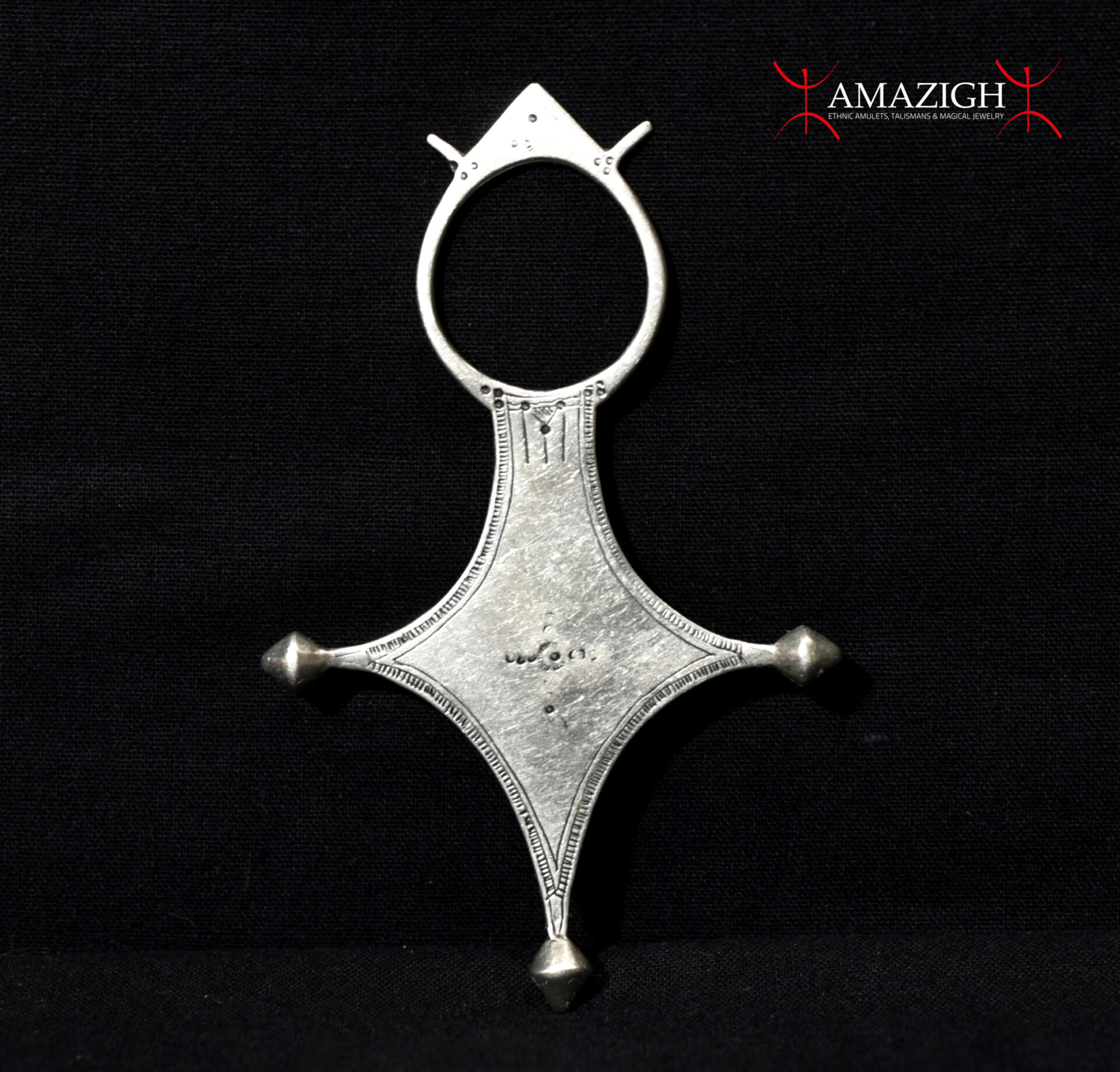
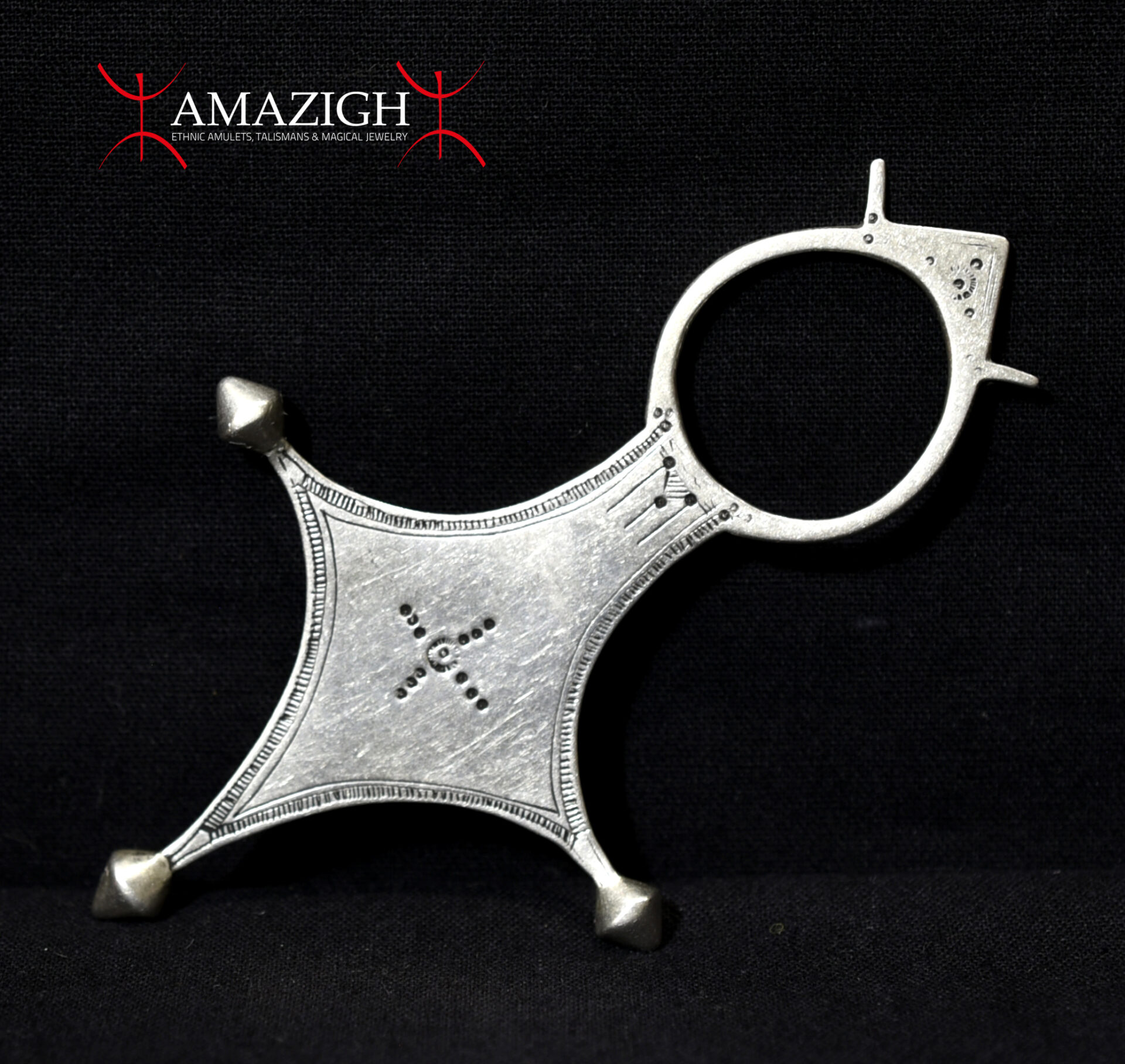
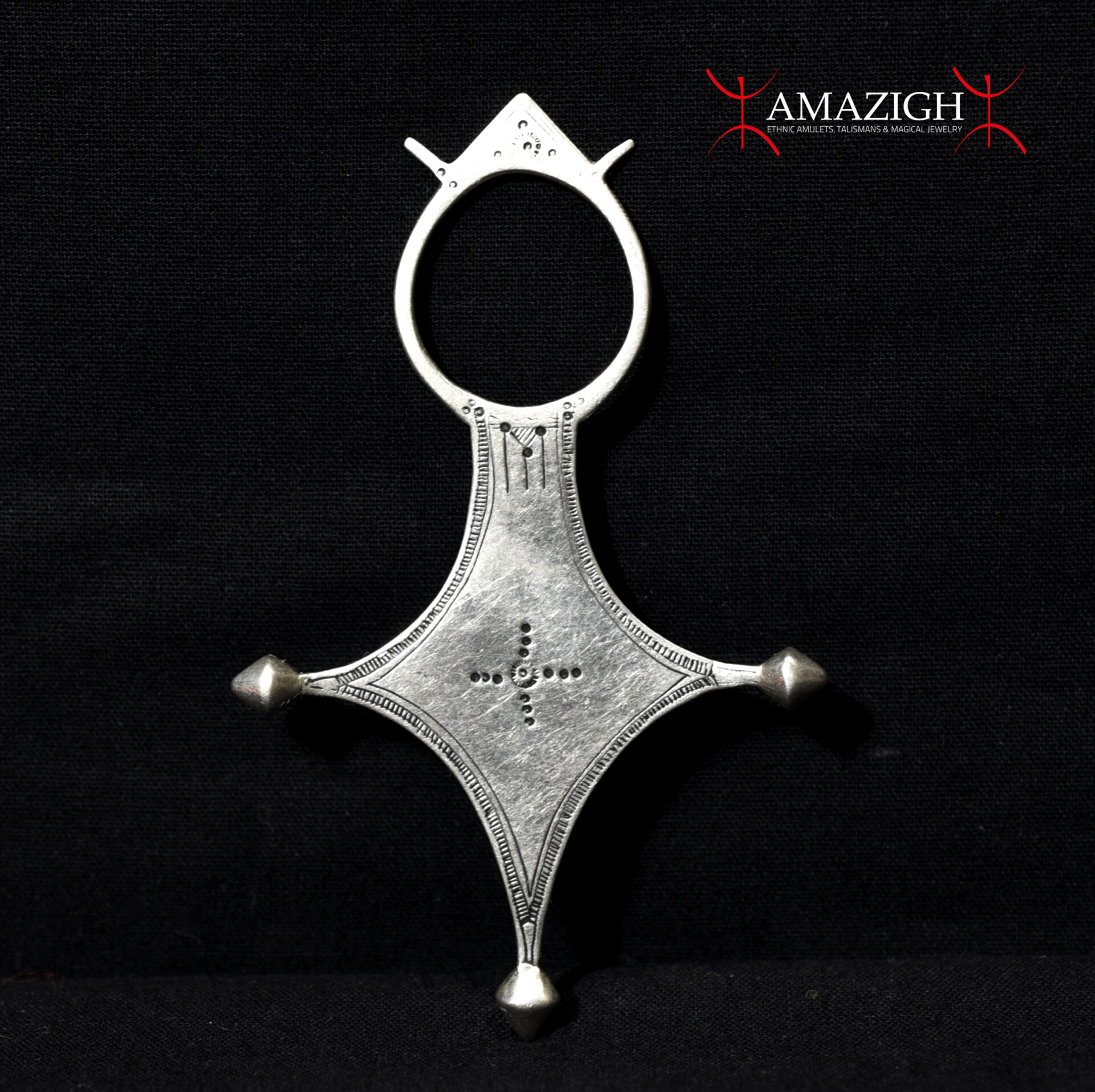
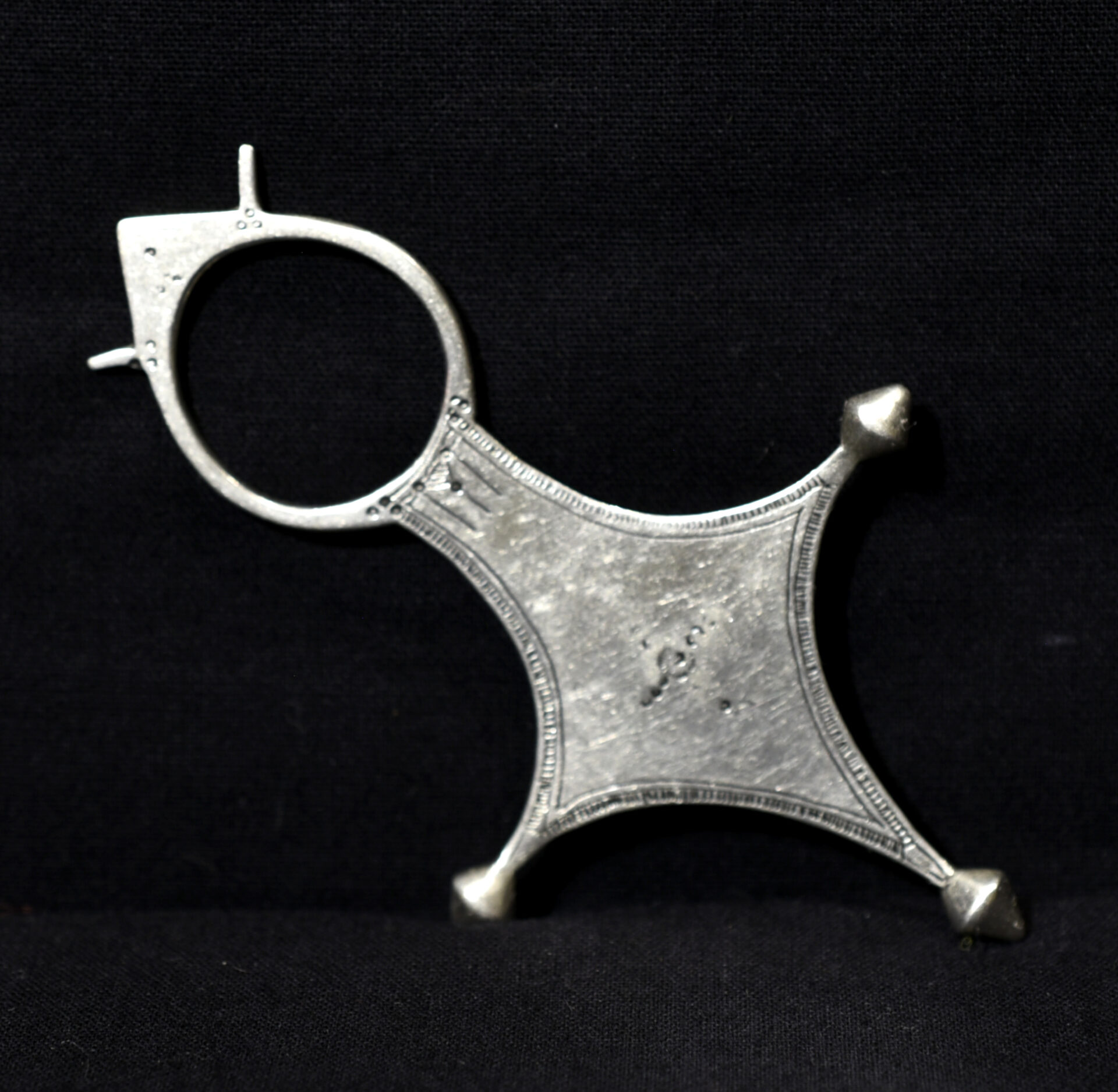
Outstanding Old, Beautiful, Large Tuareg Silver Cross – Agadez, Niger


89,95€
Silver. Weight: 15.4 g (0.54 oz). Dimensions: 10.0 × 6.3 cm (3.94″ × 2.48″). A beautiful, large, old piece.
The Tuareg live in one of the most inhospitable regions on Earth: the central Sahara Desert. Their existence, harsh and precarious, is dominated by an overriding concern to protect themselves from hostile supernatural forces believed to inhabit the surrounding environment—the Jinn (evil spirits, from the terrifying Ghul to the Ifrit, equally cruel in laying traps for travelers)—and to gain the favor of benevolent spirits.
The typical Tuareg turban, the litham, which covers the face except for the eyes, serves primarily to protect the “gates of the soul” (mouth and nostrils) from the Jinn. However, the main instruments of protection are amulets and talismans. Every Tuareg—man or woman, elder or child—wears an amulet or talisman: leather (gri-gri) or silver (khomissar, tcherot, herz), often containing magical formulas, powders of animal or plant origin, or verses from the Qur’an. Among these talismans, one often stands out: its upper part is a ring, and the lower part is lozenge-shaped with small tips—this is the Tuareg Cross.
What is the history of the Tuareg Cross? What is its origin? What does it signify? Definitive answers are elusive: we are in Africa, where everything is possible and true at once. According to the official collection of the Cooperative of Artisans of Agadez, there are 21 Tuareg Crosses, each associated with a specific place of origin. The only exception is the Karaga Cross, inspired by the traditional Tuareg bed. There are, however, four certainties:
- The term “Cross” was introduced by Europeans and is completely foreign to the Tuareg language.
- The Cross must be made strictly of silver or silver alloy. Silver is considered the metal of Allah, unlike gold, which is viewed as demonic. Mohammed formally disapproved of all metals except silver; rings, seals, and amulets made of gold, copper, or iron are prohibited in Islamic tradition.
- The archetype—the first, the true, the progenitor of all Tuareg Crosses—is the Cross of Agadez. The crosses of Iférouane, Tahoua, Zinder, and In Gall are also considered anciennes, meaning authentic and original. All others derive from these five.
- Tuareg Crosses were traditionally passed from father to son with the words: “I give you the four corners of the world, because one cannot know where one will die.”
As for their meaning, several theories exist:
- They derive from the Egyptian Ankh, which influenced the Carthaginian symbol of the goddess Tanit and, ultimately, the Tuareg Cross.
- They are a sexual symbol: in the crosses of Agadez, Zinder, and In Gall, two elements are evident—a tip (male symbol) and a ring (female symbol).
- They serve as talismans against the evil eye: many crosses feature triangular motifs, representing a stylized apotropaic eye.
- They are inspired by the Southern Cross constellation: the arrangement of its four stars (three of the first magnitude and a fourth) resembles the lower part of the diamond-shaped Agadez Cross.
morr25
- Additional information
Additional information
| Weight | 200 g |
|---|
