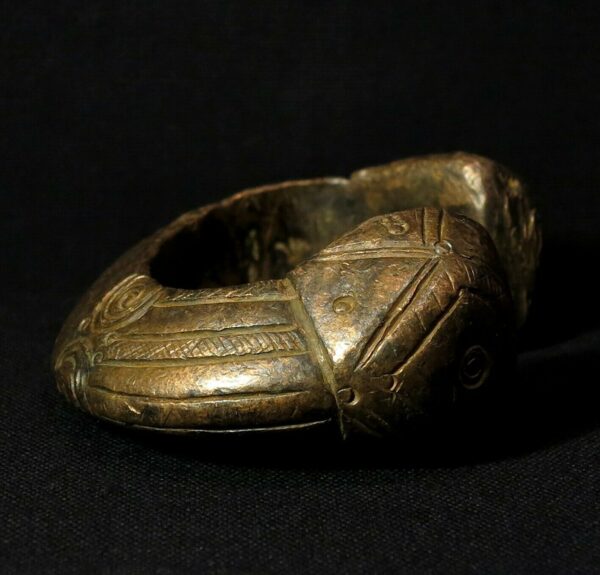
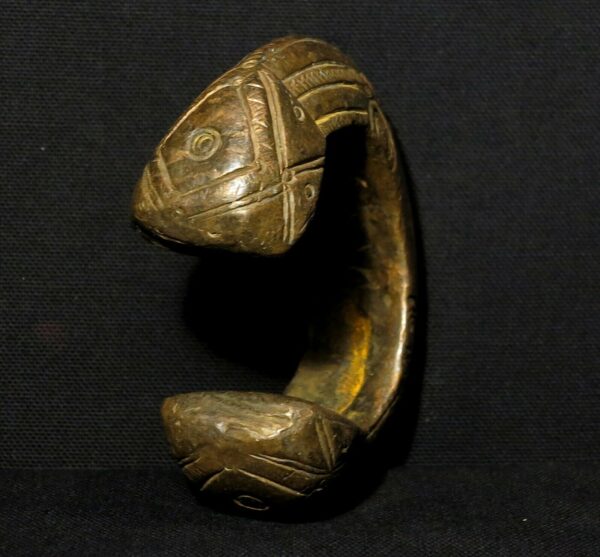


Antique Fine Yoruba Manilla – AKURE – African Currency – Nigeria
Early to mid 20th century. Copper grams 524,3 (18.49 oz.). Cm. 7,3 high x cm. 9,3 width (2.87″ x 3.66″).
Oral tradition states that Akure was founded by a prince named Omoremilekun, son of Ekun, grandson of Okanbi, and great-grandson of Oduduwa Omoluwabi, the royal progenitor of the Yoruba tribe. The prince left Ile-Ife, his fatherland, in search of a place to settle after passing a strict test administered by Oduduwa himself. This test wherein he was kept in solitude for about nine days is still annually commemorated in Akure today by the reigning king of the town during a ceremony known as ‘Oba wo ilesunta’. At the point where the prince and his party arrived at the exact location of the modern city, the string holding the heavy royal beads on his neck is said to have snapped, thus causing the people to exclaim “Àkún rẹ” (or The beads have snapped), this later becoming the name of the settlement they established on the site.
Manillas are a form of money, usually made of bronze or copper, which were used in West Africa. They were produced in large numbers in a wide range of designs, sizes, and weights. Originating before the colonial period, perhaps as the result of trade with the Portuguese Empire, Manillas continued to serve as money and decorative objects until the late 1940s and are still used as decorative objects in some contexts. The name manilla is said to derive from the Spanish for a ‘bracelet’ manella, the Portuguese for ‘hand-ring’ manilha, or after the Latin manus (hand) or from monilia, plural of monile (necklace).
We combine shipping for more items.
m22
- Additional information
Additional information
| Weight | 700 g |
|---|