



Old Baule Maternity – Bla Pokou/Abla Pokou – Côte d’Ivoire – Outstanding Piece
Carved hard wood; cm 52,3 high (20.59″); grams 3.792,0 (8.36 lb.). A fine touch patina with signs of use and age.
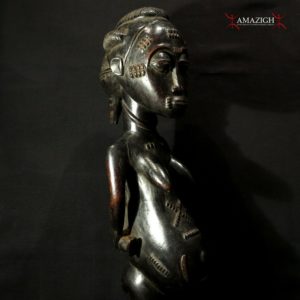
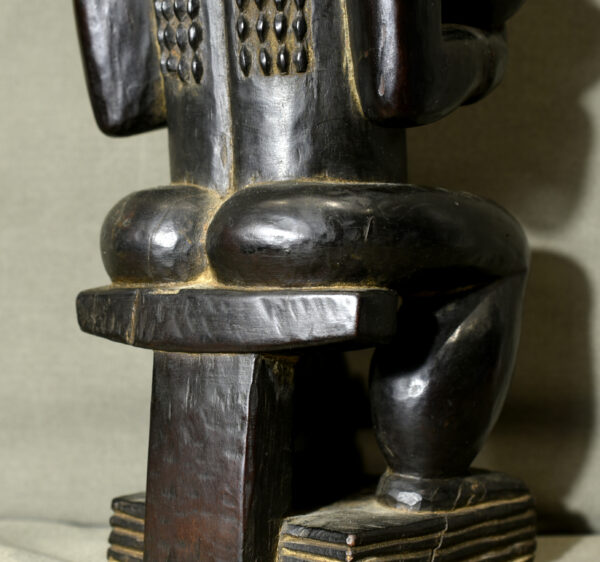
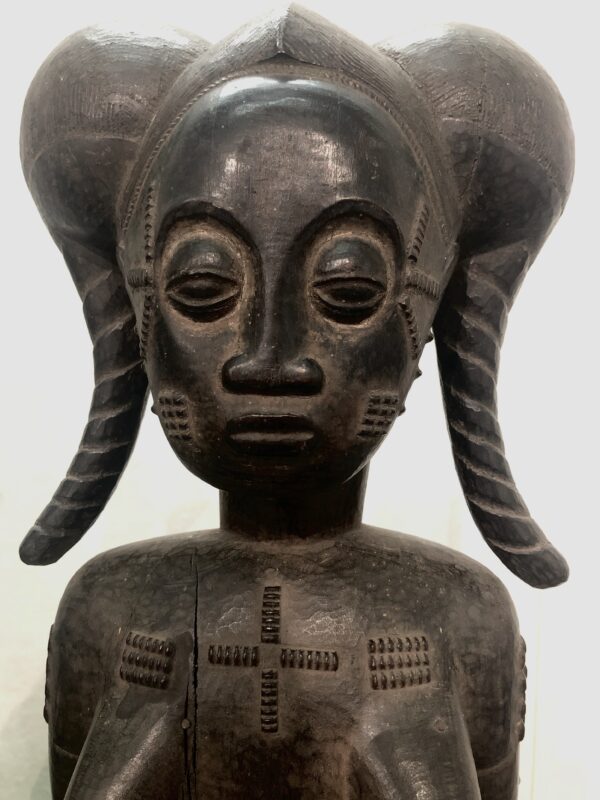
A Baule Maternity, Ivory Coast, called “La Mère Ivorienne à Bla Pokouseated on a stool, holding a child in her hands, scarification patterns on her chest, the coiufure threeparted with pigtails on each side.
Bla Pokou (also known as Abla Pokou) is a historical and legendary figure of great importance in Ivorian culture. She is often referred to as the “founding mother” of the Baoulé people.
Bla Pokou was a Princess of the Ashanti Empire (present-day Ghana). In the 18th century, fleeing a war of succession in the Ashanti Empire, she led part of her people westward, crossing forests and rivers to escape the conflict. The most famous moment in the legend tells of a very critical moment, when she was unable to cross a flooded river, diviners said that a human sacrifice was necessary to calm the waters. She then allegedly sacrificed her own only son. After the sacrifice, the waters parted to allow the people to cross.
The word “Baoulé” is said to come from this tragedy: after the sacrifice, she said “Ba ouli,” which means “the child is dead” in Baoulé. This word later became “Baoulé,” the name of the people she guided and founded. Her role as an “Ivorian mother” Bla Pokou is revered as a symbolic mother, not only because she sacrificed her child to save her people, but also because she is the figure of a courageous, wise woman leader, ready to do anything for the collective future. She therefore embodies the values of sacrifice, motherhood, courage, and unity in the Ivorian national imagination. Schools, streets, monuments, and even an animated series (“Pokou, Princess Ashanti”) pay tribute to Bla Pokou. She is taught in schools as a national heroine. Its history also symbolizes the founding and unity of a plural nation, which is particularly important in a country like Ivory Coast with many ethnic groups.
The last photo was taken at the Musée des civilisations de Côte d’Ivoire, Abidjan and features Bla Pokou (which is also the symbol of the Museum).
m20
- Additional information
Additional information
| Weight | 5500 g |
|---|