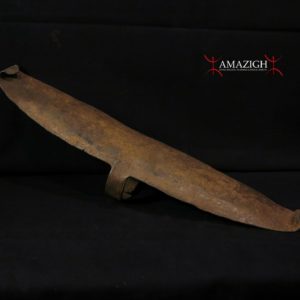
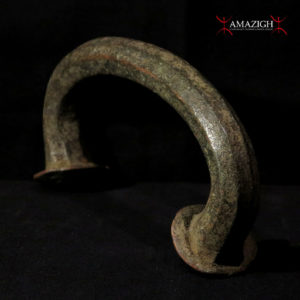
Antique Massive Hausa King Manilla – African Currency – West Africa
19th century. Copper grams 1.686,0 (59.47 oz.). cm. 13,5 wide x cm. 11,5 high (5.31″ x 4.53″).
Manillas are a form of money, usually made of bronze or copper, which were used in West Africa. They were produced in large numbers in a wide range of designs, sizes, and weights. Originating before the colonial period, perhaps as the result of trade with the Portuguese Empire, Manillas continued to serve as money and decorative objects until the late 1940s and are still used as decorative objects in some contexts.
The name manilla is said to derive from the Spanish for a ‘bracelet’ manella, the Portuguese for ‘hand-ring’ manilha, or after the Latin manus (hand) or from monilia, plural of monile (necklace).
The Hausa are a native ethnic group in West and Central Africa. The Hausa cultural practices stand unique in Nigeria and have withstood the test of time due to strong traditions, cultural pride as well as an efficient precolonial native system of government. Consequently, and in spite of strong competition from western European culture as adopted by their southern Nigerian counterparts, have maintained a rich and particular mode of dressing, food, language, marriage system, education system, traditional architecture, sports, music and other forms of traditional entertainment.
m23
- Additional information
Additional information
| Weight | 3050 g |
|---|